
Workplace Growth Daily · 2026-09-15
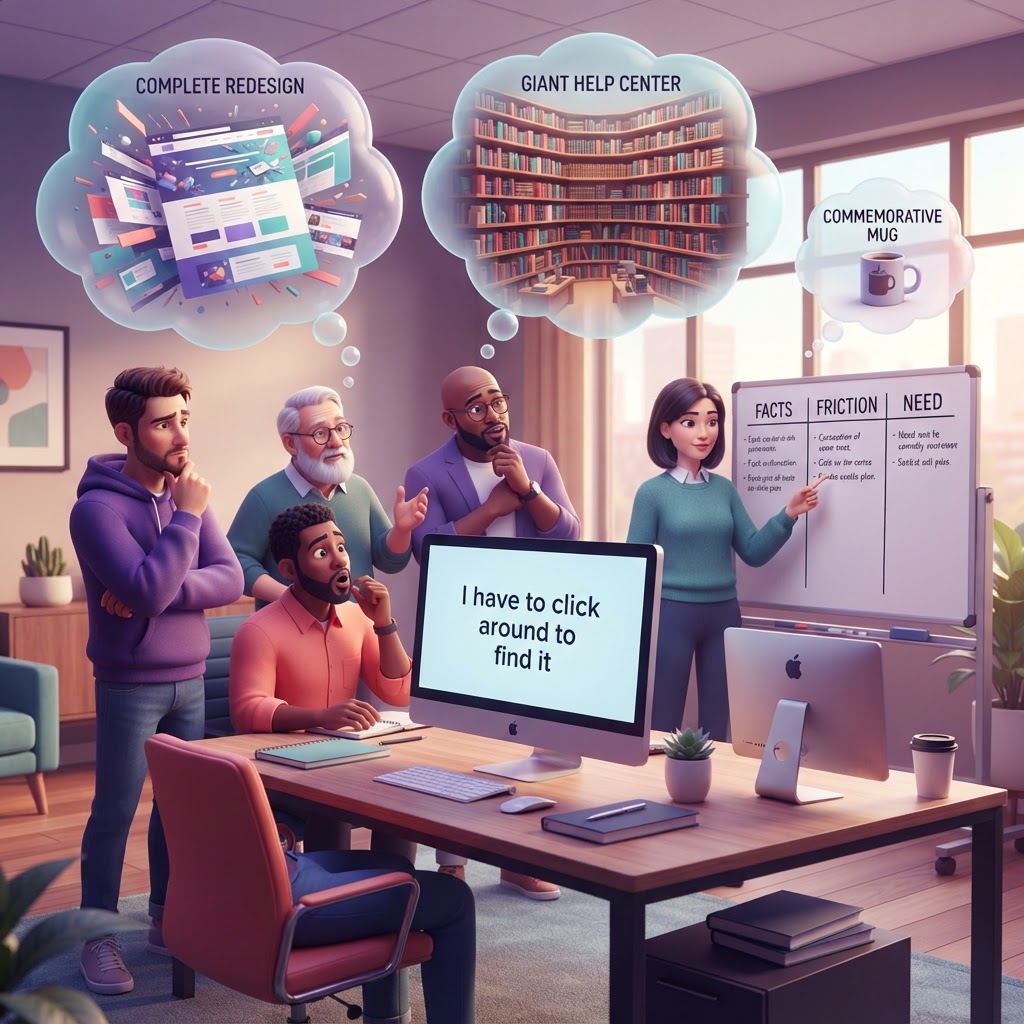
Illustrative scenario: At 09:07, a customer says, “It works, but I have to click around to find it.” By 09:12, the team has proposed a redesign, a new help centre and possibly a commemorative mug. Nobody has yet asked which click caused the trouble.
That familiar leap—from comment to grand solution—can waste effort and hide the customer’s actual need. Today’s LUMARA edition is about slowing down just enough to listen accurately, then moving quickly enough to test one modest response.
None of the supplied sources was published in the last seven days. This is therefore a research-backed practical briefing, not breaking news. The research establishes useful workplace conditions; the exercises and experiment below are LUMARA’s practical suggestions for applying them to customer listening and responsible growth.
What is changing
1. Clarity improved slightly, but employee voice remains fragile. Gallup reported that 49% of surveyed US employees strongly agreed that they knew what was expected of them in the first half of 2026, up two percentage points from 2025. However, the proportion feeling that their opinions counted declined slightly. (Gallup, 21 July 2026).
Meaning for a real team: Define what “good listening” produces—perhaps one agreed problem statement—but leave room for frontline staff to challenge assumptions. Clarity without voice can produce tidy plans built on incomplete information.
2. Direction and manager support are associated with stronger engagement. In organisations that had integrated AI, employees reporting a clear integration plan had an engagement rate 15 percentage points higher than those without a plan. Those strongly agreeing that their manager supported use reported 48% engagement, versus 30% among employees giving lower ratings. These are associations, not proof that support alone caused the differences (Gallup, 21 July 2026).
Meaning for a real team: The transferable lesson is not “add AI.” It is to give any experiment a clear purpose, boundaries and available manager support rather than simply announcing a tool or target.
3. Small pilots can expose people consequences early. CIPD recommends running people pilots alongside technology pilots so that organisations can identify workforce considerations before wider introduction. It also argues for dynamic intelligence gathering rather than relying only on static annual plans. The article is strategic guidance and cites 2024 survey data, not evidence that every pilot improves performance (CIPD, 21 July 2026).
Meaning for a real team: Test the customer-facing change and its effects on staff together. A faster response is not responsible if it creates hidden rework or an unmanageable queue.
Build a skill in 10 minutes
Skill: Signal-to-Need Listening
This is the ability to separate what a customer observed, how it affected them and what need sits underneath—before choosing a solution.
The 10-minute “Facts, Friction, Need” exercise
Use one anonymised customer comment.
- Minutes 0–2 — Read: Highlight only observable facts. Remove guesses about motive.
- Minutes 2–5 — Name friction: Complete: “The customer was trying to ___, but ___ happened.”
- Minutes 5–7 — Identify the need: Complete: “They need a clearer/faster/safer way to ___.”
- Minutes 7–9 — Ask: Write one follow-up question that could disprove your interpretation.
- Minute 10 — Check: Name evidence you still lack.
Visible success criteria: The team produces one neutral problem statement, one unmet need and one non-leading follow-up question. The statement contains no proposed feature, no blame and no invented customer intention.
Staff and management: respect in both directions
Managers should treat staff with respect, establish clear expectations, recognise useful contributions, listen without retaliation and keep workloads manageable. Apply opportunities, standards and recognition consistently. When concerns arise, investigate rather than dismiss them. Bullying is never something an employee should be expected to tolerate; use formal safeguarding, HR or reporting routes where appropriate.
Manager—say this: “For this seven-day test, success means learning whether the revised response helps customers resolve this issue. You may stop or challenge the test if workload, quality or fairness deteriorates. Thank you for raising awkward evidence early—that protects the team and the customer.”
Staff can help management by bringing a specific observation, explaining its impact and proposing a proportionate next step. Disagreement can be direct and respectful; it need not be softened into silence.
Staff member—say this: “I disagree with rolling this out yet. In three recent cases, the proposed wording did not answer the customer’s second question. Could we test it on a small sample, record follow-up contacts and review the evidence in seven days?”
If the concern involves bullying, discrimination, safety or retaliation, document what happened and use the organisation’s formal reporting or support channels—not a casual experiment.
Work better as a team
The 15-minute Customer Signal Sprint
Roles: facilitator, evidence reader, customer advocate, operations advocate and recorder. One person may hold two roles in a small team.
- 0–3 minutes: The evidence reader shares three anonymised comments about the same journey or issue.
- 3–6 minutes: Everyone silently writes the repeated facts and friction points. The customer advocate removes internal jargon.
- 6–9 minutes: Group similar signals. Do not vote on solutions yet.
- 9–12 minutes: The operations advocate flags workload, quality, accessibility or policy constraints.
- 12–15 minutes: The facilitator leads agreement on the smallest testable response.
Tangible shared output: A one-page experiment card containing: customer problem, evidence used, assumption, small change, affected group, owner, success measure, balancing measure and stop condition.
This keeps the discussion close to what customers actually said while giving delivery realities equal visibility.
Turn teamwork into measurable growth
Run a seven-day “second-contact” test
LUMARA practical suggestion: Choose one frequent, low-risk customer question. Revise a single reply, instruction or hand-off based on the Signal-to-Need exercise. Test it with a small defined group rather than changing the whole process.
- Owner: Customer Support Team Lead
- Baseline: From the previous seven comparable days, record the number and proportion of cases requiring a second customer contact within 48 hours, plus median handling time.
- Test: Use the revised response for up to 20 eligible cases during the next seven days. Keep existing escalation, privacy and quality controls.
- Primary measure: Proportion requiring a second contact within 48 hours.
- Quality check: Reviewer confirms that the reply is accurate, clear and answers the documented need.
- Balancing measure: Median handling time and the number of staff reporting that the test added unmanageable work.
- Stop condition: Pause immediately if errors, complaints, unsafe advice or workload pressure increase materially.
- Seven-day review: Compare results with the baseline, read the qualitative comments and decide to stop, adapt or extend the test.
A favourable result would justify further learning, not a guaranteed claim about retention or revenue. Customer behaviour may change for many reasons, and a small test cannot establish broad causation.
Try it today
- Select one recent, anonymised customer signal.
- Separate facts, friction and need.
- Ask one question that could disprove your interpretation.
- Create a one-page experiment card.
- Name an owner, baseline, workload measure and stop condition.
- Put the seven-day review in the calendar now.
- Thank the person who surfaced inconvenient evidence.
Discussion question: What is the smallest change we could test this week that would teach us something useful about the customer’s real need without shifting unreasonable work onto colleagues?