
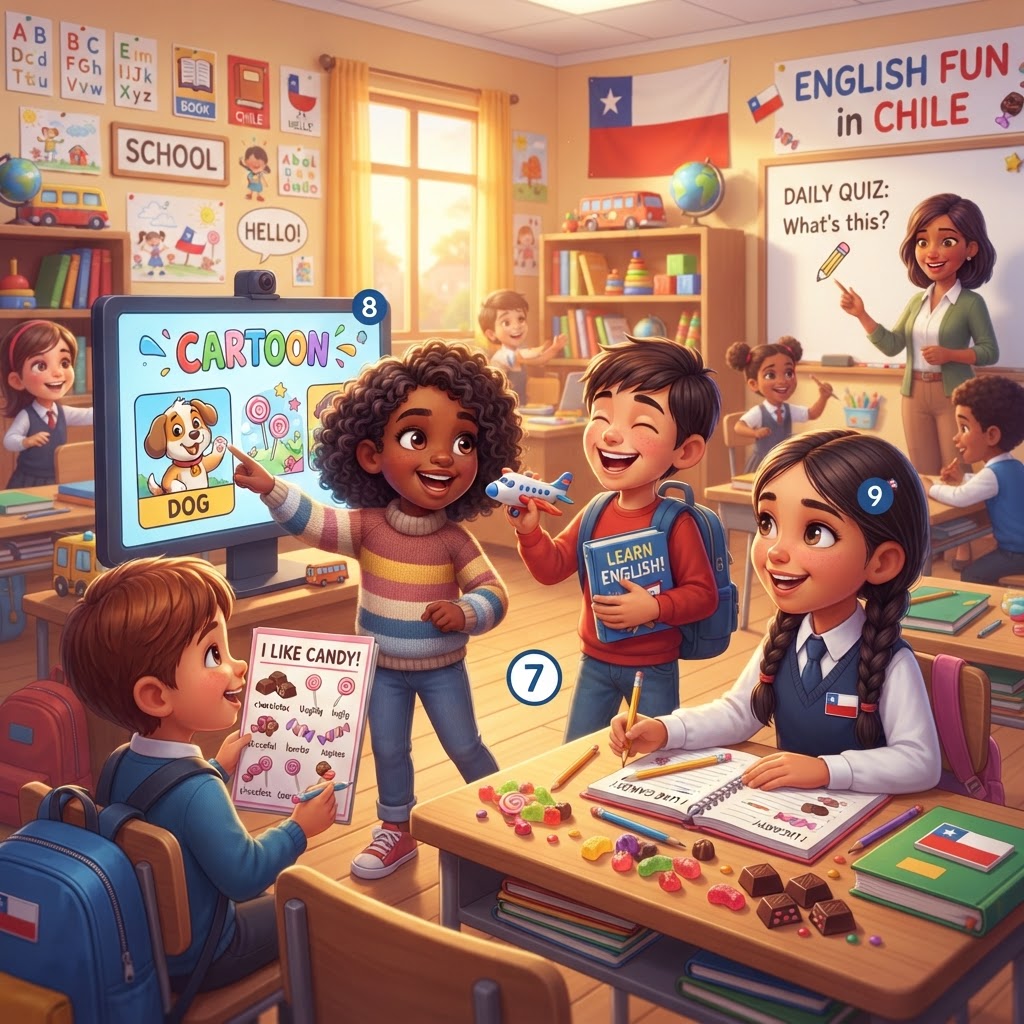
Hi, супер kids from Chile! Today we will learn English with fun things from daily life: cartoons, toys, sweet snacks, books, music, hobbies, and school words. Read step by step, say the words out loud, and have fun. You can do it!
Cartoons Kids Are Watching in Chile
Many children in Chile enjoy funny and exciting cartoons after school or on weekends. Some popular picks are Bluey, Pokémon Horizons, Miraculous, SpongeBob SquarePants, and Teen Titans Go!. These shows have jokes, adventure, teamwork, and colorful characters. In English, you can learn simple words like friend, hero, family, and adventure.
Try this: “My favorite cartoon is Bluey.” or “I like funny heroes.”
Toys & Collectibles
Kids also love cool things to build, trade, and collect. In Chile, many children enjoy trading cards, building blocks, mini figures, plush toys, slime kits, football stickers, and puzzle cubes. Collecting can be fun because you can organize, count, trade, and talk about your favorite items in English.
Useful words: card, collection, toy, sticker, build. Example: “I have three cards.” “This is my toy collection.”
Sweet Treats & Candies
Chile has many sweet snacks that kids know and enjoy. Some famous treats are Super 8, Chokita, Trencito, Golpe, Sahne-Nuss mini chocolate, and crunchy cookies or wafer snacks. These are fun words to describe food in English: sweet, chocolate, crunchy, soft, and snack.
Example: “This snack is sweet.” “I like crunchy cookies.” Remember: sweets are tasty, but water, fruit, and balanced meals help us stay strong too.
Books & Stories
Reading is a great way to grow your English. Many kids enjoy funny and exciting books like Dog Man, Diary of a Wimpy Kid, The Wild Robot, and the Chilean classic Papelucho. Some children also like myths, comics, mysteries, and animal stories.
Reading tip: choose a book with pictures, short chapters, or a topic you love. Example sentences: “This book is funny.” “The robot is kind.” “I read at night.”
Music & Dance
Music makes English practice fun! Many kids listen to clean pop songs, animated movie songs, school-safe dance music, K-pop dance tracks, and family party music like cumbia. In Chile, students may also dance cueca at school celebrations. Music helps with rhythm, memory, and pronunciation.
Useful words: song, dance, beat, sing, move. Example: “I sing with my friends.” “We dance to the beat.”
Hobbies & After-School Fun
After school, many children in Chile enjoy football, basketball, biking, skating, drawing, crafts, video games, chess, music lessons, robotics, and reading clubs. Some kids make friendship bracelets, paint mini pictures, or learn easy recipes with family.
Try saying: “My hobby is drawing.” “I play football after school.” “I go to robotics club on Friday.” Hobbies help us learn new words and make new friends.
School Subjects Vocabulary
Here are useful school words in English. Read them and practice with the examples.
- Math = matemáticas. Example: “Math is fun today.”
- Science = ciencias. Example: “We learn about plants in Science.”
- History = historia. Example: “History tells stories from the past.”
- Art = arte. Example: “I draw a cat in Art.”
- Music = música. Example: “We sing in Music class.”
- P.E. = educación física. Example: “We run in P.E.”
- Homework = tarea. Example: “My homework is short today.”
- Recess = recreo. Example: “I play with my friends at recess.”
Can you make your own sentence with Science or Art?
Grammar Power-Up
1) There is / There are
En inglés usamos there is para hablar de una cosa y there are para hablar de dos o más cosas.
Example: “There is a book on my desk.” = “Hay un libro en mi escritorio.”
Example: “There are three cards in my bag.” = “Hay tres cartas en mi mochila.”
2) I like + noun / I like + verb-ing
Usamos I like para decir lo que nos gusta. Puede ir con un sustantivo o con un verbo terminado en -ing.
Example: “I like music.” = “Me gusta la música.”
Example: “I like reading.” = “Me gusta leer.”
Quick Quiz
- Which cartoon was named in the post? Bluey, Space Pirates, or Robot Jungle?
- What school subject can help you learn about plants? Science, Recess, or Music?
- Which sentence is correct for many things? There are three cards. or There is three cards.?
Great job reading in English today. Keep practicing a little every day!
School & Pop Vocabulary
| English | Español | Example |
|---|---|---|
| Math | matemáticas | Math is fun today. |
| Science | ciencias | We learn about plants in Science. |
| History | historia | History tells stories from the past. |
| Art | arte | I draw a cat in Art. |
| Music | música | We sing in Music class. |
| P.E. | educación física | We run in P.E. |
| Homework | tarea | My homework is short today. |
| Recess | recreo | I play with my friends at recess. |
Grammar Power-Up
There is / There are
Usamos "there is" para hablar de una sola cosa y "there are" para hablar de dos o más cosas.
🇬🇧 There are three cards in my bag.
🇨🇱 Hay tres cartas en mi mochila.
I like + noun / I like + verb-ing
Usamos "I like" para decir lo que nos gusta. Puede ir con un sustantivo o con un verbo terminado en -ing.
🇬🇧 I like reading.
🇨🇱 Me gusta leer.
Quick Quiz
1. Which cartoon was named in the post?
2. What school subject can help you learn about plants?
3. Which sentence is correct for many things?