

September 21, 2026 • Chile edition
Spring Has Entered the Chat 🌸
Chile is waking up from winter, fandom timelines are chaotic, and your English glow-up is officially in its training arc. Let’s learn through music, anime, fantasy, and pop culture—because boring lessons are not canon here.
1. Today's Obsessions
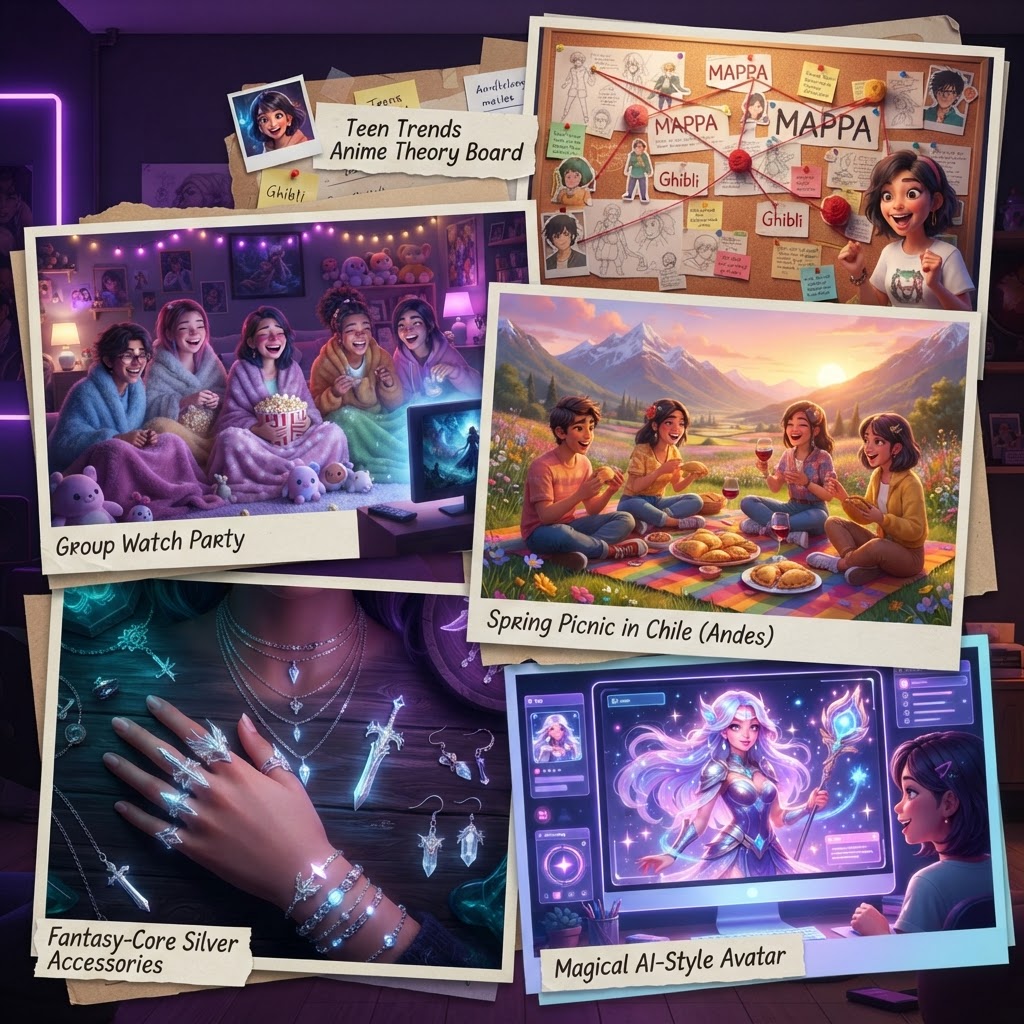
1. Spring reset videos: Chilean creators are sharing room makeovers, picnic fits, study resets, and allergy-season survival tips.
2. Anime finale theories: Fans are posting wild predictions, character rankings, and edits before the autumn anime season wraps up.
3. Fantasy-core fashion: Capes, silver jewelry, enchanted-forest colors, and outfits that say, “I definitely own a secret sword.”
4. AI fantasy avatars: People are turning themselves into magical heroes, villains, and suspiciously attractive side characters.
5. Cozy fandom watch parties: Group chats are choosing comfort movies and series for cool Chilean evenings. Snacks are mandatory; spoilers are banned.
2. English Through Lyrics

Song Pick: “Birds of a Feather” by Billie Eilish
This song has a dreamy but intense emotional tone. It explores loyalty, deep attachment, and the fear of losing someone important. It is perfect for practicing emotional English without needing a dictionary every three seconds.
Key vocabulary: forever = para siempre; stick together = permanecer unidos; obsessed = obsesionado/a; uncertain = inseguro/a o incierto/a.
Idiom: “Birds of a feather” describes people who are similar and naturally spend time together. In Spanish, think “Dios los cría y ellos se juntan.”
Try it: “My best friend and I are birds of a feather because we both love fantasy books and chaotic playlists.”
3. Anime English Corner

Frieren: Beyond Journey’s End
Frieren is an elf mage who once defeated a powerful enemy with a group of heroes. Because elves live for a very long time, human life feels short to her. After losing old friends, she begins a new journey and tries to understand people, memories, and love more deeply.
Character adjectives: Frieren is calm, powerful, thoughtful, and emotionally distant. Fern is responsible, observant, and caring. Stark is brave, loyal, and sometimes anxious.
Fan debate: Is Frieren’s emotional distance a weakness, or does it help her understand life differently?
4. Binge Watch English

Wednesday
Wednesday Addams studies at Nevermore Academy, investigates a dangerous mystery, and tries to survive friendships without admitting that she cares. Her dry humor and iconic expressions make the series great for learning tone and sarcasm.
Slang and useful phrases: “That’s sus” means something is suspicious. “No big deal” means it is not very important. “I’m not buying it” means you do not believe an explanation. “Give me a break” shows annoyance or disbelief.
Mini comprehension task
Why does Wednesday investigate Nevermore’s mystery?
A. She wants to become class president.
B. She discovers dangerous secrets connected to the school.
C. She needs content for her dance account.
5. Pop Culture Tea in English

Soft tea only: fandom culture is becoming more interactive. Fans are not simply watching stories—they are creating edits, playlists, theories, cosplay, and alternate endings. Actors and musicians also tease projects with mysterious photos or tiny clues, sending group chats into detective mode.
For English learners, this is secretly useful. Captions teach short expressions, interviews train listening skills, and fan theories help you practice words such as “might,” “could,” and “probably.”
Tea phrase: “They dropped a hint” means they shared a small clue without revealing everything.
6. BookTok & YA Bestsellers

Powerless by Lauren Roberts
In a kingdom where powerful abilities decide your social status, Paedyn must hide the fact that she has no special power. After saving a prince, she enters a dangerous competition. Secrets, rivalry, attraction, and survival follow. Basically: enemies-to-lovers tension plus fantasy danger equals zero sleep.
Themes: identity, inequality, courage, trust, and survival.
Key vocabulary: powerless = without power; disguise = something that hides your identity; trial = a difficult test or challenge.
7. Which One Are You?
Choose the option that sounds most like you:
A. I make playlists for fictional characters.
B. I pause every episode to explain my theory.
C. I buy books faster than I read them.
D. I pretend to be chill, but I am emotionally attached to the whole cast.
Mostly A: Soundtrack Sorcerer. Mostly B: Lore Detective. Mostly C: Book Dragon. Mostly D: Secret Softie. Every result is valid—and extremely fandom-coded.